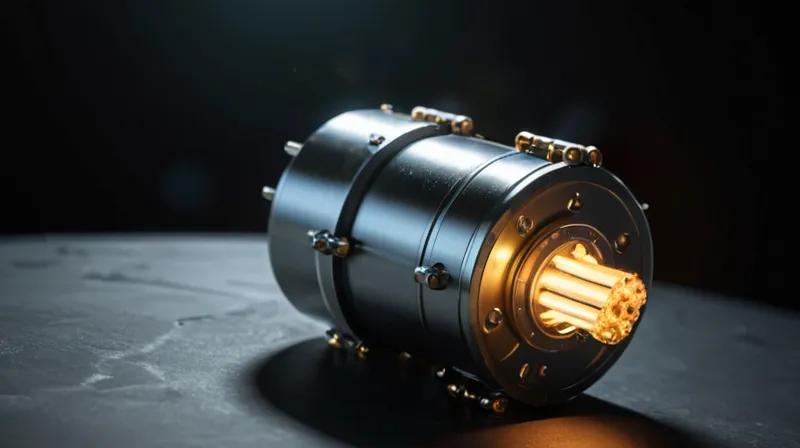
In a groundbreaking development for commercial spaceflight, City Labs, a Miami-based company, has successfully launched what it claims is the world’s first commercial nuclear-powered satellite. The satellite, named BOHR, was transported into orbit aboard a SpaceX Falcon 9 rocket on July 7 as part of the Transporter-17 rideshare mission, alongside 80 other payloads.
Revolutionary Tritium Battery Powers the Future
BOHR is a CubeSat roughly the size of a softball, equipped with a tritium-based nuclear battery — a technology that harnesses the energy released from the decay of tritium, a radioactive isotope of hydrogen. Unlike traditional solar panels, this nuclear battery promises a consistent power source that doesn't rely on sunlight, making it ideal for long-duration missions in deep space or orbits where solar exposure is limited.
The satellite’s launch marks a quiet but significant milestone in the nuclear age’s expansion into space. While nuclear power has long been used in scientific and military satellites, this is the first time such technology has been commercialized for small satellites. City Labs envisions a future where nuclear-powered CubeSats could be deployed in deep space missions, planetary exploration, or even as part of a global communication network.
Implications for the Future of Space Exploration
With the growing demand for small satellites and the limitations of solar power in certain orbital environments, nuclear batteries could revolutionize how spacecraft operate in space. BOHR’s mission will focus on demonstrating the reliability and efficiency of its nuclear power system, which could pave the way for more advanced missions in the coming years.
Industry experts are closely watching this development, as it could signal a shift toward more robust, long-term power solutions for space exploration. As space becomes increasingly crowded and complex, technologies like nuclear-powered satellites may become essential for sustaining long-term operations in orbit and beyond.
Conclusion
City Labs' successful launch of BOHR represents a major step forward in the commercialization of nuclear power for space. While the technology is still in its early stages, the mission could open doors for a new era of space exploration and satellite operations, where reliability and longevity are paramount.