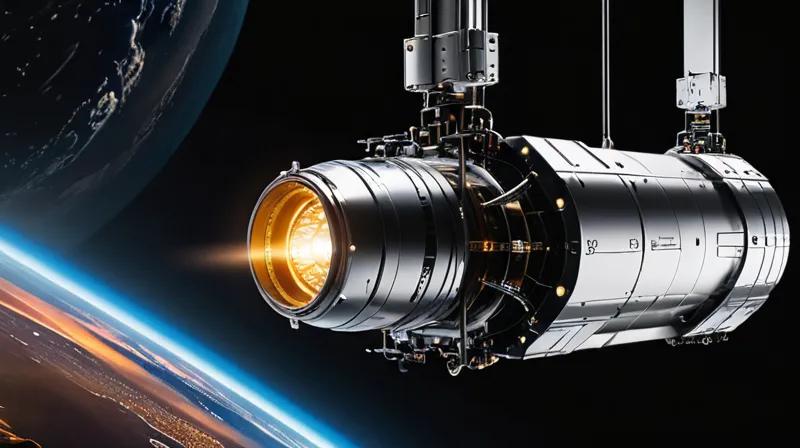
ATMOS Space Cargo has just raised €25.7M in funding to advance Europe's first routine orbital return service, marking a significant step toward commercial space logistics. This development is not just about rockets and capsules — it's deeply rooted in autonomous re-entry guidance systems, orbital mechanics, and AI-driven trajectory optimization. Understanding this requires diving into the complex interplay of aerospace engineering, control theory, and machine learning algorithms that govern how spacecraft navigate the extreme conditions of atmospheric re-entry.
What is Autonomous Re-Entry Guidance?
Autonomous re-entry guidance refers to the ability of a spacecraft to independently determine and execute its descent path through Earth's atmosphere without real-time human intervention. This is a critical capability for any orbital service provider aiming to offer routine, cost-effective return missions.
In the context of ATMOS Space Cargo’s PHOENIX 2 vehicles, this involves sophisticated model predictive control (MPC) systems and adaptive algorithms that process real-time data from onboard sensors such as accelerometers, gyroscopes, and atmospheric density monitors. These systems must account for variables like atmospheric drag, thermal loads, and gravitational anomalies during descent.
How Does It Work?
The core of autonomous re-entry guidance lies in nonlinear control theory and machine learning integration. During re-entry, a spacecraft experiences extreme conditions: temperatures can exceed 1,500°C, and aerodynamic forces can be 100 times greater than during orbital flight. The guidance system must compute a trajectory that minimizes fuel consumption while ensuring structural integrity and passenger safety.
Modern systems employ deep reinforcement learning (DRL) models trained on vast datasets of simulated re-entry scenarios. These models learn to balance optimization objectives such as minimizing delta-v (change in velocity) or maximizing payload capacity. The state-space representation of the vehicle's dynamics is continuously updated using sensor fusion, where data from multiple sources (GPS, inertial measurement units, barometers) are combined via extended Kalman filters or particle filters to estimate the vehicle's current state accurately.
For example, in the case of ATMOS’s 1-tonne capsule, the system must dynamically adjust its angle of attack and thrust vectoring to manage heat flux and deceleration. The AI component iteratively refines these decisions using multi-objective optimization frameworks that weigh safety, cost, and mission success probability.
Why Does It Matter?
Autonomous re-entry guidance is foundational to scalable, commercial spaceflight. Without it, missions remain dependent on ground-based command centers, which limits operational flexibility and increases costs. As ATMOS moves from demonstration to operations, the ability to autonomously return cargo and potentially humans from orbit is a key enabler for a space economy that relies on routine orbital logistics.
This technology also underpins orbital debris mitigation strategies, where precise re-entry control ensures spacecraft burn up safely or land in designated zones. Furthermore, it is essential for space traffic management as more commercial and government entities launch satellites and vehicles into orbit.
Key Takeaways
- Autonomous re-entry guidance combines control theory, AI, and sensor fusion to enable spacecraft to navigate the complex physics of atmospheric descent.
- Advanced model predictive control and deep reinforcement learning algorithms are essential for optimizing descent trajectories under extreme conditions.
- Systems like those developed by ATMOS are critical for the future of commercial orbital logistics and space sustainability.
- The transition from demonstration to routine operations represents a major milestone in space commercialization and orbital return services.