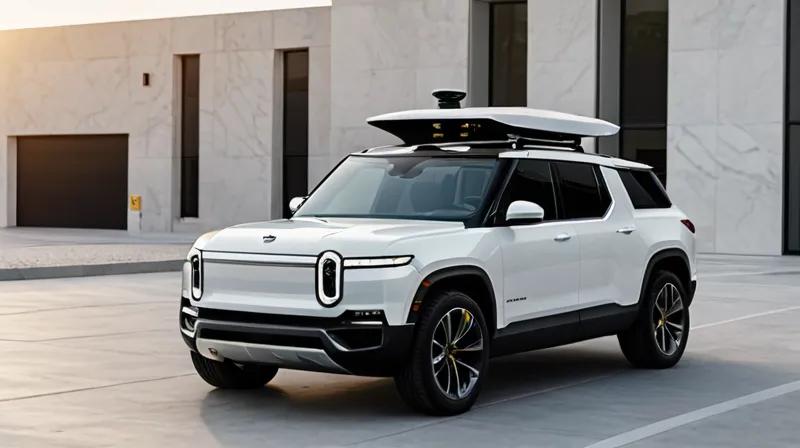
Rivian CEO RJ Scaringe has signaled a major milestone in the evolution of autonomous driving, claiming that supervised point-to-point self-driving capabilities will be available in all of the company's second-generation vehicles and the R2 later this year. Speaking at the Masters of Scale event in Anaheim, Scaringe positioned this technology as "very similar to Tesla’s FSD," directly comparing the two approaches in the competitive landscape of autonomous vehicle development.
A Three-Stage Roadmap to Autonomy
Scaringe outlined a structured, three-stage autonomy roadmap for Rivian’s future vehicles. The first stage involves basic driver assistance features, while the second stage introduces supervised point-to-point driving — a significant leap that allows vehicles to navigate from a starting point to a destination with minimal human intervention. The final stage, fully autonomous driving, remains a long-term goal. By focusing on the second stage, Rivian is aiming to offer a practical, near-term solution that bridges the gap between current semi-autonomous systems and fully driverless vehicles.
Competitive Landscape and Market Implications
The announcement comes amid growing competition in the autonomous vehicle space, with Tesla’s Full Self-Driving (FSD) beta leading the charge. Tesla’s FSD has been a subject of both hype and scrutiny, with users and analysts debating its real-world performance and safety. Scaringe’s comparison suggests Rivian is confident in its own approach and is positioning itself as a serious contender in the race to commercialize autonomous driving.
This move could have broader implications for the electric vehicle market, especially as Rivian continues to expand its lineup. The integration of supervised point-to-point driving may also influence how ride-hailing platforms like Uber and Lyft approach robotaxi deployment, potentially accelerating the adoption of autonomous technologies in shared mobility services.
Conclusion
With Rivian’s promise to roll out supervised point-to-point self-driving this year, the company is not only advancing its own technological capabilities but also asserting its place in a rapidly evolving industry. As the race for autonomy heats up, Rivian’s approach may offer a compelling alternative to Tesla’s FSD, especially as consumers and fleet operators seek reliable, near-term solutions.