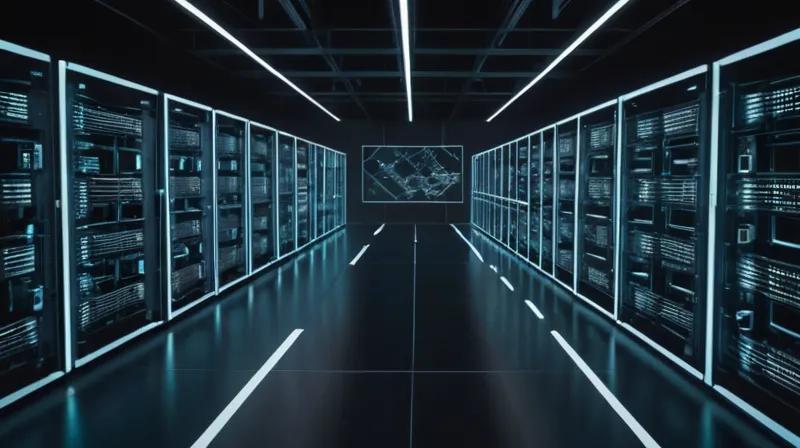
Understanding Data Center Capacity and Energy Infrastructure for AI
Data centers are the backbone of modern artificial intelligence systems, serving as the physical infrastructure where machine learning models are trained, deployed, and operated. The recent SoftBank announcement of a €75 billion investment in French data centers represents a critical infrastructure commitment that illustrates the intersection of energy capacity planning, data center scalability, and AI compute requirements.
What is Data Center Capacity?
Data center capacity refers to the total amount of computational and storage resources available within a facility, typically measured in terms of power consumption (watts or kilowatts) and compute performance (FLOPS - floating-point operations per second). The SoftBank investment targets 5 gigawatts (5,000 megawatts) of additional capacity, which represents an enormous computational infrastructure commitment.
Modern data centers require substantial electrical power not only for computing hardware but also for cooling systems, which can consume up to 40% of total energy usage. The capacity measurement includes both the electrical infrastructure and the physical space required for server racks, networking equipment, and supporting systems.
How Does Data Center Capacity Work?
The relationship between data center capacity and AI performance follows a fundamental scaling law. As AI models grow in complexity and size, they require exponentially more computational resources. A typical large language model like GPT-4 requires approximately 100-200 petaflops (10^15 FLOPS) of compute power during training, which translates to massive energy consumption.
Power capacity in data centers is managed through several key components:
- Power Distribution Units (PDUs) - These distribute electrical power from the main grid to individual server racks
- Uninterruptible Power Supplies (UPS) - Provide backup power during outages
- Transformers and Voltage Regulation - Step down high-voltage power to levels suitable for computing equipment
- Energy Storage Systems - Enable load balancing and peak shaving
The 5 gigawatt target represents approximately 5,000 megawatts of continuous power, which could support roughly 100,000 high-end servers, each consuming 50 kilowatts of power. This calculation assumes typical server power consumption of 200-500 watts per core, with modern AI servers often requiring 10-20 cores each.
Why Does This Matter for AI Development?
The exponential growth in AI compute requirements creates a fundamental infrastructure bottleneck. As AI models scale, they demand more data, more training time, and more computational resources. This investment pattern reflects the increasing energy intensity of AI development.
Several factors drive this demand:
- Model Size Scaling - Modern AI models grow exponentially in parameters, with GPT-4 having approximately 1.76 trillion parameters, requiring massive compute clusters
- Training Time Reduction - Faster training cycles require more parallel computing resources
- Edge Computing Integration - Distributed AI systems require additional data center capacity across multiple locations
Energy efficiency metrics become critical in this context. The data center industry has seen a shift toward more efficient liquid cooling systems and specialized AI chips (like NVIDIA's H100) that deliver higher performance per watt. However, even with these improvements, the raw energy requirements continue to increase dramatically.
The SoftBank investment also reflects strategic positioning in the European AI landscape, where regulatory frameworks and energy costs significantly impact infrastructure decisions. The €75 billion commitment suggests a long-term strategy for maintaining competitive advantage in AI development.
Key Takeaways
This investment demonstrates the fundamental relationship between energy infrastructure and AI capability. The 5 gigawatt target represents not just a power measurement, but a strategic commitment to future AI development. As AI systems become more sophisticated, the energy requirements will continue to grow, making infrastructure planning increasingly critical for AI advancement.
Advanced data center planning must balance energy efficiency with compute performance, requiring sophisticated power management systems and strategic infrastructure investments. The SoftBank announcement signals that AI development is reaching a point where infrastructure capacity directly determines technological progress.

