Introduction
Modern smartphones and portable chargers are increasingly susceptible to overheating during fast charging, a phenomenon that has become a significant bottleneck in device performance and safety. This issue stems from the fundamental physics of energy conversion and thermal management in lithium-ion batteries. As devices become more powerful and charging speeds increase, the heat generated during charging can exceed safe operational limits, triggering thermal throttling and potentially compromising battery longevity. The recent development by TORRAS, a company specializing in smart charging technology, addresses this challenge through advanced thermal management strategies that incorporate real-time monitoring and dynamic power adjustment.
What is Thermal Throttling and Why Does It Occur?
Thermal throttling is a protective mechanism employed by electronic devices to prevent overheating and potential damage. It operates by reducing the power consumption or processing speed of a device when its internal temperature exceeds predetermined thresholds. In the context of power banks and smartphones, this occurs due to the inherent inefficiencies in energy conversion processes. When charging a device, electrical energy is converted into chemical energy stored in the battery. However, this conversion is not 100% efficient, with a portion of the energy lost as heat. The relationship between power input (P), energy efficiency (η), and heat generation (Q) can be expressed as:
Q = P × (1 - η)
As charging speeds increase, the power input (P) escalates, leading to proportionally higher heat generation. This heat accumulates within the device's compact form factor, where thermal dissipation becomes increasingly challenging. The heat capacity and thermal conductivity of the materials used in power banks, particularly the battery cells and circuitry, determine how effectively this heat can be dissipated. When thermal limits are exceeded, the device's control systems automatically reduce charging power to prevent thermal runaway, a dangerous condition where heat generation exceeds dissipation, potentially causing permanent damage or even fire hazards.
How TORRAS Implements Smart Thermal Management
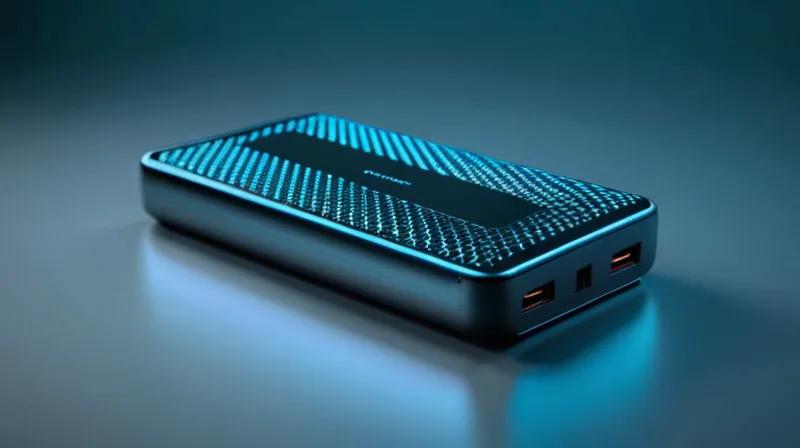
TORRAS addresses this challenge through a combination of hardware and software innovations that enable dynamic power adjustment based on real-time thermal monitoring. Their approach involves integrating advanced temperature sensors throughout the power bank's circuitry, creating a comprehensive thermal map of the device. These sensors continuously monitor temperature variations across different components, including the battery cells, charging circuits, and power management ICs. The data is processed through proprietary algorithms that employ machine learning models trained on thermal behavior patterns under various charging conditions.
The system operates on a feedback control loop that adjusts charging parameters in real-time. When temperature thresholds are approached, the algorithm dynamically reduces charging current while maintaining optimal charging efficiency. This is mathematically modeled using a control system equation:
I(t) = I_max × (1 - α × T(t)/T_max)
Where I(t) is the instantaneous charging current, I_max is the maximum current, T(t) is the current temperature, and T_max is the maximum safe temperature threshold. The coefficient α represents the sensitivity of current reduction to temperature changes. This approach allows for maintaining high charging speeds while preventing thermal damage, a significant improvement over traditional fixed-temperature throttling methods.
Why This Matters for the Broader Tech Ecosystem
This advancement represents a critical evolution in portable power management systems, with implications extending beyond individual consumer devices. The principles underlying TORRAS's solution are applicable to various battery-powered systems, including electric vehicles, wearable devices, and IoT sensors. The integration of machine learning algorithms into thermal management systems demonstrates the growing convergence of AI and hardware engineering in solving practical engineering challenges. This approach also contributes to battery longevity, as reduced thermal stress significantly extends the lifespan of lithium-ion cells, which degrade more rapidly under high-temperature conditions.
Furthermore, this technology addresses scalability challenges in the rapidly expanding market for high-power charging solutions. As wireless charging and fast-charging standards continue to evolve, with USB-PD (Power Delivery) protocols supporting up to 240W charging, thermal management becomes increasingly critical. The ability to maintain high charging speeds while ensuring safety represents a significant breakthrough in consumer electronics engineering.
Key Takeaways
- Thermal throttling occurs when heat generation exceeds dissipation capacity, causing automatic power reduction in charging systems
- Advanced power banks like TORRAS use real-time temperature monitoring and machine learning algorithms for dynamic power adjustment
- The mathematical relationship between power input, efficiency, and heat generation determines thermal limits in charging systems
- This technology improves both charging speed and battery longevity by preventing excessive thermal stress
- The approach demonstrates the integration of AI into hardware engineering for practical problem-solving in consumer electronics